Creating a Narrative of Progress: Broadening the Definition of Reading Growth

Read the whole blog on CCIRA here.

This spring, we were kidwatching during Independent Reading in a first grade classroom. A boy with a huge pile of books in front of him beckoned us over. “Listen to me read!” he said gleefully. He read book after book, pointing out all the funny parts. “I’m a good reader!” he proclaimed. 

Later, his teacher confided in us, “I’m worried that no one will recognize his growth. No one will know how he felt about himself as a reader in September and compare it to how he feels about himself now.  They won’t see the joy that reading brings him or how he sees it as part of his life now, when in September he only occasionally picked up a book.  They will just see his level on the test and label him as a struggling reader.”

This encapsulates the ongoing contradiction between how reading growth is traditionally measured and defined by tests, and what teachers observe and experience to be a more complete concept of reading growth. Current policy and testing practices continue to reinforce the misconception that student reading growth encompasses solely the accumulation of skills and strategies (Afflerbach, 2022), thereby reducing the definition of what constitutes reading growth.  However, both the experience of teachers and an overwhelming amount of research tell us reading is more complex than that. What constitutes reading growth and how it is measured needs to better reflect this complexity (ILA, 2018), expanding to include aspects of reading such as engagement, motivation and self-efficacy. 

What we see as growth, and what students feel is growth is disconnected from what is officially recognized as growth.  At the end of the school year, reading growth is too often reduced to a grade on the report card or  a number or letter, or is defined by a set of discrete skills that can be measured by  standardized tests.  These measures do not capture the joy or the nuances of being a reader.

What data counts?

Data promises to inform and support the work of teachers, and yet data has become a burden.  In reality, many teachers are drowning in data, and not the sort of data they find useful.  Typically, the data teachers are directed to utilize is confined to big data such as standardized tests, universal screeners or benchmark data. That sort of data is often used to tell a story of “learning loss” or name who is “below grade level.”    A recent Hechinger report (February, 2022) asked “…  has all that time teachers spent studying data helped students learn? The emerging answer from education researchers is no.” This comes as no surprise to educators themselves. The big data that is valued by the system is not the data that supports the work of teachers in classrooms in meaningful ways, yet it tends to dominate our time, our definitions of achievement,  and the stories told about our students and our work.

An over reliance on this big data runs the risk of narrowing the vision of the role of the teacher.  When framed by deficit-minded data, the teacher turns into someone who fills gaps  and catches students up to the benchmarks that indicate grade level proficiency.  

Our role is to teach responsively, not to “fill gaps.”  Our role is to be asset-minded. Our role is to assume a stance of non-judgemental relentlessness in the pursuit of growing readers. Our role is to uncover student strengths and provide relevant feedback that will build upon those strengths. Our role is to center students. In our hearts, we know that big data often limits our role as teachers of readers and does not tell the whole story of our students.  When small data, such as kidwatching or conferring notes, is valued, we are suddenly presented with a more nuanced portrait of growth that indicates relevant next steps for each student.

Navigating the Contradiction

We urge teachers to harness their sense of agency and take control of the narrative by expanding the definition of reading growth to tell an authentic  story of progress. Maxine Greene, the great educational philosopher, believes that teachers have an obligation to choose to engage with struggle, such as the contradiction discussed above.  She states that by engaging in these struggles, rather than giving in to one side or the other, teachers can move toward a state of “wide awakeness” that welcomes the creativity and agency necessary to humanize and transform possibilities in education.  In Releasing the Imagination (1995)she writes, “…to learn and to teach, one must have an awareness of leaving something behind while reaching toward something new, and this kind of awareness must be linked to imagination.” How can we navigate this contradiction  and imagine new spaces of possibility for our students and ourselves? 

Here are some practical ways to navigate this contradiction:

  • Prioritize Independent Reading and the Read Aloud

Both Independent Reading and the read aloud are research-backed literacy practices that satisfy standards while meeting students where they are.  Independent Reading time has the potential to develop reading comprehension ability, vocabulary, grammar and spelling (Krashen, 2004), spark actions for a more just world, (German, 2021), improve reading fluency (Allington, 2014) … and the list of advantages goes on and on.   Every student has the right to Independent Reading; it is not an add-on or a luxury.  Similarly, the read aloud is an enjoyable and impactful time of day. Effective read-alouds increase children’s vocabulary, listening comprehension, story schema, background knowledge, word recognition skills, and cognitive development. (ILA, 2018).

During Independent Reading and the read aloud, teachers have the opportunity to engage in intentional kidwatching, to notice and name the strengths of students as readers, and to begin to build a broad understanding of reading growth for each child across the school year. During Independent Reading and the read aloud, students have the opportunity to be their authentic reading selves.

  • Honor, consider and follow the growth of the identity of each reader

 On this blog in March  of 2021, we shared our definition of reading identity (Reflection and Discovery: The Power of Reading Identity in Independent Reading ) We define reading identity as having five aspects: attitude, self-efficacy, habits, book choice and process.  If we use these aspects as a jumping off point for imagining what reading growth means, then reading growth becomes authentic and includes much more than a grade. Reading growth can (and should)  include:

  • Choosing different genres
  • Reading for longer periods of time
  • Having favorite books
  • Using a variety of strategies to decode words independently
  • Holding on to multiple plot lines and characters
  • Comparing and contrasting genres and books
  • Responding to texts in a variety of ways
  • Wanting to read
  • Knowing book preferences
  • Declaring: “I am a reader.”

As you  confer with students during Independent Reading, provide feedback on what you observe about their growth. Invite students in class discussions to reflect on how they have grown as readers. Ask: “What are the ways in which you have changed as a reader?  What made you change?”  Encourage students to tell stories about themselves as readers and how their reading life has developed. 

  • Reclaim Your Role

Regie Routman (2003) writes that “teaching with urgency means focusing relentlessly on what is most important every single day.”  Therefore, teaching with urgency means to teach responsively, to start with student strengths and to provide relevant feedback that build upon those strengths with clear next steps. Students are what is most important every single day.  It is through the lens of deep understanding of our students as readers and learners, that we must approach curriculum, assessment and methods of instruction.  To put students at the center, teachers must continuously reflect on the impact of their decisions, the curriculum and assessment opportunities.  It also means that as a result of this reflection, teachers feel a sense of agency to not only embrace and expand upon what is working, but to give themselves the grace to let go of those practices, routines or tasks that no longer invite positive or productive outcomes for students.

 In one classroom, a veteran fourth-grade teacher chose to abandon a read aloud text that had worked for years, because it no longer captured the attention of her class.  Instead, she presented the class with a variety of possible texts that fit the genre and purpose of her current instruction; when the students were involved in picking the read aloud, their engagement in class discussions soared.  In another classroom, a teacher realized that she never got to the read aloud, because it was at the end of the day. She changed the schedule so that she started the day with the read aloud. Students were actively involved in class conversations, and the read aloud became a jumping off point of instruction. 

  • Trust Small Data and Broaden the Definition of Reading Growth

We know that big data does not tell the whole story. Instead, big data measures such as state tests might show that students are “behind” or “at mastery” or “meet the standard.”  

In contrast, small data, such as kidwatching notes, presents a more nuanced portrait of growth and indicates relevant next steps for each student.  It provides actionable, in-the-moment data upon which teachers can take action.  Take charge of how time in data-focused meetings is spent. Shift team meetings to include analysis of small data; focus on naming strengths, and the natural next steps that build upon those strengths.  In tandem, these two moves can shift both the instructional and emotional climate to embrace a narrative of progress that is beneficial to the morale and growth of students and educators alike.

Final Thoughts

So how are you going to move forward? We urge you to focus on and imagine what could be, rather than feeling weighed down by what is, because imagining and expanding upon what reading growth can and should encompass is a step toward reclaiming a narrative of progress. 

We urge you to take the brave step of moving away from limited definitions of growth and advocating for all that counts when we consider the authentic reading lives of students in and beyond school. For teachers, a wider stance allows us the ability to center students and focus on teaching readers, not just reading. For students, this wider stance honors their authentic reading lives, their whole reading identities and their everyday reading successes.

As your school year comes to a close, know that your observations of students and students’ reflections  count as data. Encouraging your students to believe in themselves as readers, and supporting students to understand their identities as readers counts as growth. Broadening your students’ repertoire of strategies counts as growth. Nurturing your students’ sense of trust that they are and will continue to be readers counts as growth.  It all counts.  

Dr. Jennifer Scoggin has been a teacher, author, speaker, curriculum writer, and literacy consultant.  Jennifer’s interest in the evolving identities of both students and teachers and her growing obsession with children’s literature led her to and informs her work. 

Hannah Schneewind has been a teacher, staff developer, curriculum writer, keynote speaker and national literacy consultant. She brings with her over 25 years of experience to the education world. Hannah’s interest in student and teacher agency and her belief in the power of books informs her work with schools.

Together, Jen and Hannah are the authors of Trusting Readers: Powerful Practices for Independent Reading, published by Heinemann. They are the  co-creators of Trusting Readers (@TrustingReaders), a group dedicated to collaborating with teachers to design high quality literacy opportunities that invite all students to be engaged and to thrive as readers and writers.

Works Cited:

Afflerbach, Peter. 2022. Teaching Readers (Not Reading): Moving Beyond Skill and  Strategies to Reader-Focused Instruction. New York, NY: The Guilford Press. 

Allington, Richard L. 2014. “How Reading Volume Affects Both Reading Fluency and Reading Achievement.” International Electronic Journal of Elementary Education 7 (1):95-104. https://files.eric.ed.gov/fulltext/EJ1053794.pdf.

German, Lorena. 2021.  Textured Reading: A Framework for Culturally Sustaining Practices. Portsmouth, NH: Heinemann.

Greene, Maxine. 1995.  Releasing the imagination: Essays on education, the arts and social change.  San Francisco, CA: Jossey-Bass.

Hechinger Report. 2022. Proof Points: Researchers blast data analysis for teachers to help students.  New York, NY: https://hechingerreport.org/proof-points-researchers-blast-data-analysis-for-teachers-to-help-students

International Literacy Association (ILA). 2018.  Literacy Leadership Brief: The Power andPromise of Read-Alouds and Independent Reading.  No. 9445. Newark, DE https://www.literacyworldwide.org/docs/default-source/where-we-stand/ila-powerpromise-read-alouds-independent-reading.pdf.

Krashen, Stephen. 2004. The Power of Reading: Insights from the Research.Santa Barbara, CA: Libraries Unlimited.

Routman, Regie. 2003. Reading Essentials: The specifics you need to teach reading well.  Portsmouth, NH: Heinemann.
Why a Broad View of Reading Growth is Exactly What Teachers and Students Need Right Now

Read the whole blog on Heinemann here.

As the school year comes to a close, we imagine that during Independent Reading you are kidwatching and admiring how much and in how many ways the children have grown as readers. As you kidwatch, remember those early days of the school year when Independent Reading lasted 10 minutes. Remember when students were hesitant to share their ideas with a reading partner. Now, reflect how far your readers have come. Consider the conversations they can have now, the books they are choosing now, the way they see themselves as readers now. Linger in that joy. 

That growth did not happen by chance; that growth happened because of your instructional decision making that centered students.

This is why a broad view of reading growth is exactly what teachers and students need right now. Too often, reading growth at the end of the school year is reduced to a number or letter alone; reading growth is defined by a set of discrete skills that can be measured by standardized tests. These standardized tests don’t capture the joy of what actually happened in your classroom over the last school year, but those tests are what “count” as data. Growth in a student’s attitude toward reading or ability to choose a broader range of texts to read isn’t counted. 

The disparity between what is tested and what we value is not new. In 1995, NCTE warned that a “…preoccupation with large-scale testing leads to distortion and reduction…” (NCTE Resolution, November 30, 1995.) Current policy and testing practices still reinforce the misconception that student reading growth encompasses only the accumulation of skills and strategies (Afflerbach, 2022), narrowing the definition of what constitutes reading growth. As practitioners, we know that reading is more complex than that. What constitutes reading growth and how it is measured needs to better reflect this complexity (ILA, 2017) and include aspects of reading such as engagement, motivation and self-efficacy. Because it all counts.

As your school year comes to a close, please don’t spend time regretting what you didn’t get to or focusing on what the students still can’t do. Instead, use your teacher-collected formative small data, such as kidwatching notes, conferring notes, artifacts and reflections from the students themselves, to tell the story of each reader. This way, you will tell a narrative of progress for you and the students.

What does reading growth encompass?

Thinking about what reading growth encompasses involves measuring the immeasurable. How a student develops and changes as a reader in a school year under the expert guidance of a teacher isn’t quantifiable. To imagine new spaces of possibility for broadening the definition of reading growth, we turn to the role of reading identity. In an earlier post, we described reading identity as having five aspects (attitude, self-efficacy, habits, book choice and process) that develop throughout the entire year.

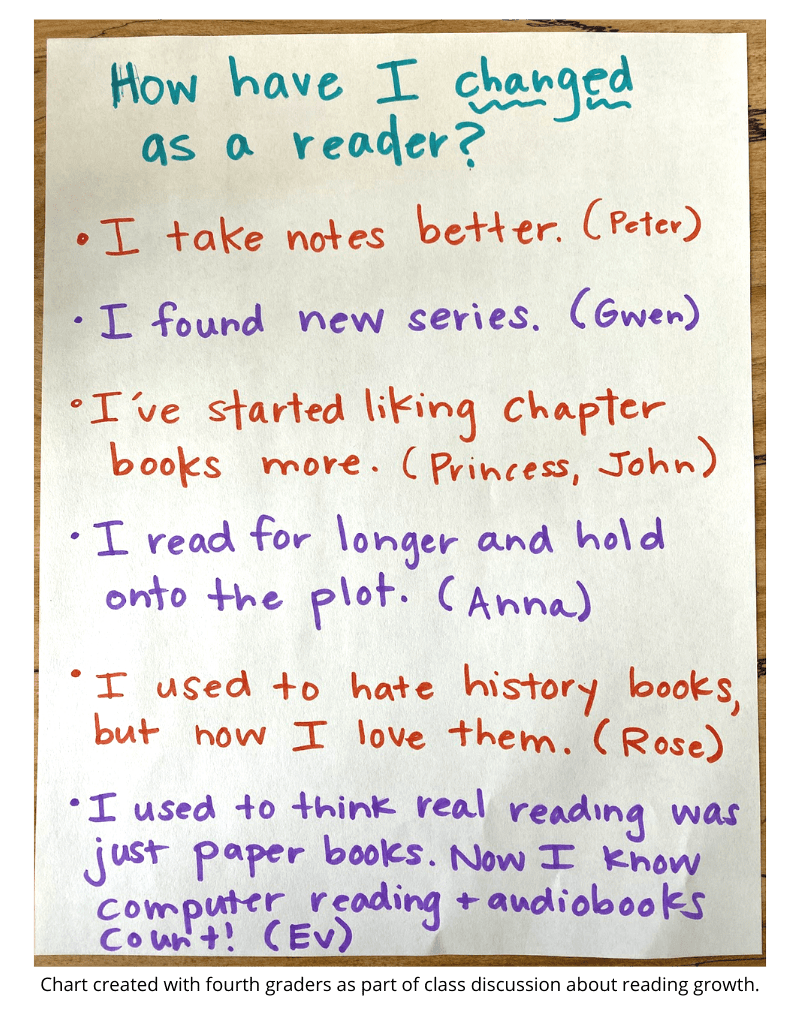
Using these five aspects as a guide, we collaborated with teachers and students to make the immeasurable more visible. When we posed the question “What is reading growth?” in conversations with teachers and in classrooms with students, their answers were wonderfully varied. Here a sampling of responses:

Reading growth can mean finding a new series.
Reading growth can mean reading for longer stretches of time.
Reading growth can mean choosing to read when there is extra time.
Reading growth can mean determining and learning lessons in a novel.
Reading growth can mean talking with a new partner.
Reading growth can mean learning more about a topic.
Reading growth can mean talking about your thinking as a reader.
Reading growth can mean changing your mind after reading about an issue.
Reading growth can mean discovering a new author or genre.
Reading growth can mean having a wider repertoire of decoding strategies.
Reading growth can mean understanding that putting in effort leads to growth.
Reading growth can mean finding new favorites. 
Reading growth can mean feeling that you are a reader.

This wider stance on reading growth offers teachers and students space to learn and develop within a narrative of success. Success breeds success both for teachers and students. This start to a more nuanced and inclusive definition of reading growth not only honors the successes teachers and students experience every day, it contributes to a larger conversation about what it means to teach readers, not just reading.

Expanding reading growth in your classroom
As teachers, we can look for visible signs of growth through kidwatching, listening and conferring. These are among your richest sources of data. At the same time, we also want to ensure that a larger understanding of what it means to grow as a reader is something we convey to students. 

By starting conversations about growth with, What are the ways in which you have changed as a reader? What made you change?, we help make the idea of growth more concrete and at the same time push students to consider the reason for that change. This helps them see how their efforts led to that change and realize that those same efforts could lead to future change as well. Prompt students as needed with additional questions to encourage them to consider all aspects of reading identity. These questions might include: What new reading habits have you developed? What have you learned about yourself as a reader? What reading challenge did you overcome? What are you proud of?

Here are several suggestions for integrating talk about reading growth into your classroom:

Conduct an inquiry into reading growth.

  • Start with the prompts: “What are the ways in which you have changed as a reader? What made you change?”
  • Encourage students to tell stories about themselves as readers and how their reading life has developed. They might include details such as the first book they read on their own, their old preferences and how they have changed over time, or strong reading memories from school or home. What do these stories teach students about what it means to grow as a reader?
  • Spark conversations by revisiting class artifacts, such as previous class anchor charts, student reading responses, class read-alouds from earlier in the year or lists of students’ book choices throughout the year.

Devote time to ReDiscovery conferences.

  • In initial Discovery Conferences, you devote time to learning about students’ identities as readers. Imagine what insights you and your students could glean from ReDiscovery conferences.
  • Add the word “now” to the original questions.
  • Include questions such as the ones suggested in the reading growth inquiry (above) to guide the students to reflect on their growth in all aspects of reading identity.

Support students as they reflect on their own reading growth.

  • Encourage students to draw or write about how they have grown or changed as readers, prompting them to consider all aspects of their identity as readers: habits, self-efficacy, attitude, book choice and process.
  • This work can also be supported by re-visiting classroom artifacts such as old reading responses, classroom anchor charts or browsing former favorites in the classroom library.
  • Some students may choose to reflect alongside a partner, using their partner’s reflections to build upon their own.

Invite students to celebrate their growth.

  • Tailor this celebration to match the work your students have done around reading growth and their preferences for sharing. Keep in mind that some students might want to share, while other students might feel more comfortable keeping their reflections to themselves.
  • Options include gallery walks, Padlets, Jamboards, and partner or small group conversations in the class or with different classes.
  • Write letters to the next year’s teacher telling that teacher about their reading identity, reading growth, and hopes for the upcoming year of reading.

Trust That All Growth Counts

What do you want to carry with you as you close the year? Carry with you a trust in your instructional decision making. Carry with you a belief in yourself as an impactful teacher of readers. Carry with you the grace to let go of practices that are not effective. Carry with you your ability to imagine possibilities for each one of your students.

What do you want your students to carry with them as they leave your classroom? Encourage students to carry with them a strong belief in themselves as readers. Encourage students to trust that they are now and will continue to be readers into the summer and the next school year. Encourage students to understand that their efforts led to their growth as readers. 

End the year as you started it, by trusting yourself and trusting readers.

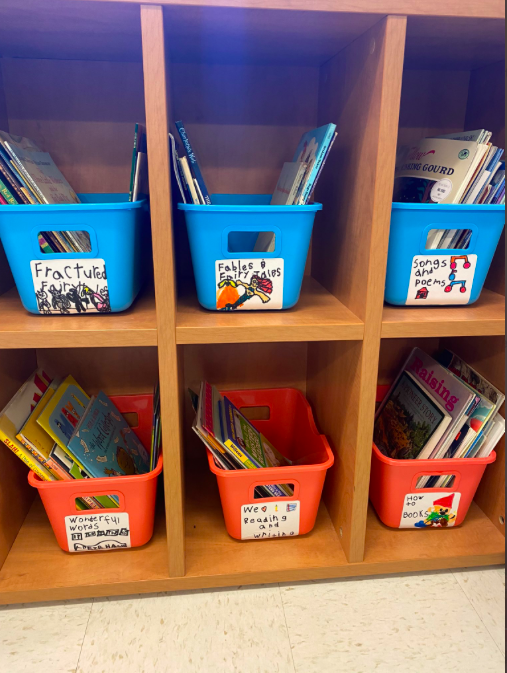
Student Designed Libraries

Dear Teachers,

Are you wondering about how to get your students involved in setting up the classroom library? It may seem overwhelming. We get it. Here’s a way to do it without dismantling the library that you have already set up:

  • Gather the students around the library. (We understand that this is tricky depending on the guidelines that are in place.)  Ask the students what they notice about how the library is already set up.  Put their ideas on a chart. 
  • Explain that you put the library together by thinking about what books they would want to read and that you wanted to make it easy for them to find those books. Tell them now it is their turn to set up the library in a way that makes sense to them.
  • Spread some new books  on the floor. Ask the students to think about how they would put the books together. Would these books go in baskets that are already in the library? Do we need to make and label some new baskets?
  • You can repeat this process for an entire week; it can take 10 minutes a day, in small groups and with partners. By the end of the week, you will have a number of new baskets, the students will have a sense of ownership over the classroom, and the energy for Independent Reading will go up as they pick books from the library that they created. 

Here are some examples to inspire you. So go ahead and get started! What’s the best that could happen?

Warmly,
Jen & Hannah

Why Independent Reading is Exactly What Students Need Right Now

As the school year approaches the half-way point, reflective educators everywhere are taking a close look at student growth, considering what next steps for each reader might be and making plans for relevant future instruction. Too often, this reflection is coupled with pressure to fit in all the units of study or to cover predetermined grade-level content. As a result, teachers are caught between what their students actually need and what curriculum requires, (even when these two needs are at odds with one another).
This is why independent reading is exactly what you and your students need right now…and always. Independent reading is a research-backed literacy practice that satisfies this balance while also nurturing the unique voices and purposes for reading of each student. Independent reading time and again has demonstrated the potential/ability to develop reading comprehension ability, vocabulary, grammar and spelling (Krashen, 2004), spark critical conversations and actions for a more just world (German; Bomer & Bomer), improve reading fluency (Allington, 2014), nurture empathy (Laminack & Kelly, 2019), build content knowledge (ILA, 2018), and nurture resilience (Routman, 2002)…and that’s just the start of the list. It doesn’t get much better than that.

Continue Reading on Heinemann

Reflection and Discovery: The Power of Independent Reading in Reading Identity

Over the course of our careers, we have always found reflection a valuable tool in our efforts to match our beliefs to our actions. As young, idealistic, energetic first year teachers, we would often stand in our empty classrooms at the end of the day and reflect on each part of the day.  After a particularly challenging day, our reflections included questions such as: “How did I react in the moment when things went awry? How do I want to handle those moments? What can I do differently tomorrow?”  After a particularly successful day, our questions shifted to: “What did I do that worked today? How can I do that again tomorrow?” As classroom teachers and now as consultants, regardless of how the day goes, our reflective work centers around three key questions of identity:
Who am I as a teacher?  
Who do I want to be as a teacher?  
How do I get there?
Read Entire Blog on CCIRA

Letting Go of Labels and Trusting Reading Identity

My son pours over illustrations and devours graphic novels, especially those with sophisticated potty humor.  Dav Pilkey has mythical status in our house. Garfield comics abound.  Chris Van Dusen’s illustrations merit hours of close study.
Yet despite his love of reading at home, my son did not see himself as a successful reader at school.  During independent reading, he studied the illustrations and rarely focused on the words. By October of first grade, he was labeled as “disengaged” and a “struggling reader.” And although those words were never said directly to him, he felt their weight.  
My son watched his friends read increasingly difficult texts and was aware that he could not read the words with similar success.  His teacher tried to support him. However,  she inevertantly made the all-too-common, label-led decision to focus on what my son was notdoing as a reader. She focused on word solving strategies yet, he rarely applied these strategies to his independent reading.  Over time, my son internalized the message that his interactions with the illustrations were not a strength, they were a distraction.  
In March of first grade, COVID happened.  Overnight, my work as a literacy consultant  disappeared.  And as a mom, my work with my own reader took on a new life.  My husband and I decided to homeschool Charlie through second grade.  I was back in the classroom…or the basement that we now use as a classroom.  
Read Entire Blog on Nerdy Book Club Here

Building Better Independent Reading: Creating Classroom Spaces for Independent Reading

Teachers have the unique opportunity to start fresh each year. This fresh start often begins with designing the classroom space for a new group of students. Think of the classroom as a blank canvas for your students; what messages does it send about the type of learning that is promoted and valued in that space?  As we linger in classrooms, we uncover the stories of individual and collective learning. 

View the entire blog on Heinemann